China Top IPL vs Laser Hair Removal Which Is Better?

Time:2026-11-15 Author:Mason
0%

Choosing between China’s top IPL and laser hair removal devices depends on more than price or advertised power. Both use light energy to target pigment in hair follicles, but they are not the same technology. IPL delivers a broad range of light wavelengths, while laser systems use a more focused wavelength. So, what is the difference between IPL and laser hair removal in practical use? It can affect treatment precision, comfort, suitability, and the number of sessions needed.

Results vary. Hair color, skin tone, treatment area, device settings, and operator experience all matter. Dark, coarse hair often responds better than light, gray, or red hair, because these contain less of the pigment that light-based treatments target. IPL devices may offer adjustable filters and wider treatment areas, while laser systems may provide more targeted energy. Neither option guarantees permanent hair removal; long-term reduction and maintenance needs differ from person to person.

A sensible comparison should look beyond a product label. Check the device’s intended use, cooling system, energy controls, safety features, service support, and available clinical evidence. For professional treatments, ask who will operate the equipment and how settings are chosen for your skin and hair. For home-use devices, follow the manufacturer’s instructions and avoid treating irritated or recently tanned skin. Small details matter.

No device suits everyone. Claims such as “painless” or “works for all skin types” deserve careful scrutiny. This guide compares IPL and laser technology, explains practical trade-offs, and outlines questions to ask before choosing a device or treatment. There may be no single winner.
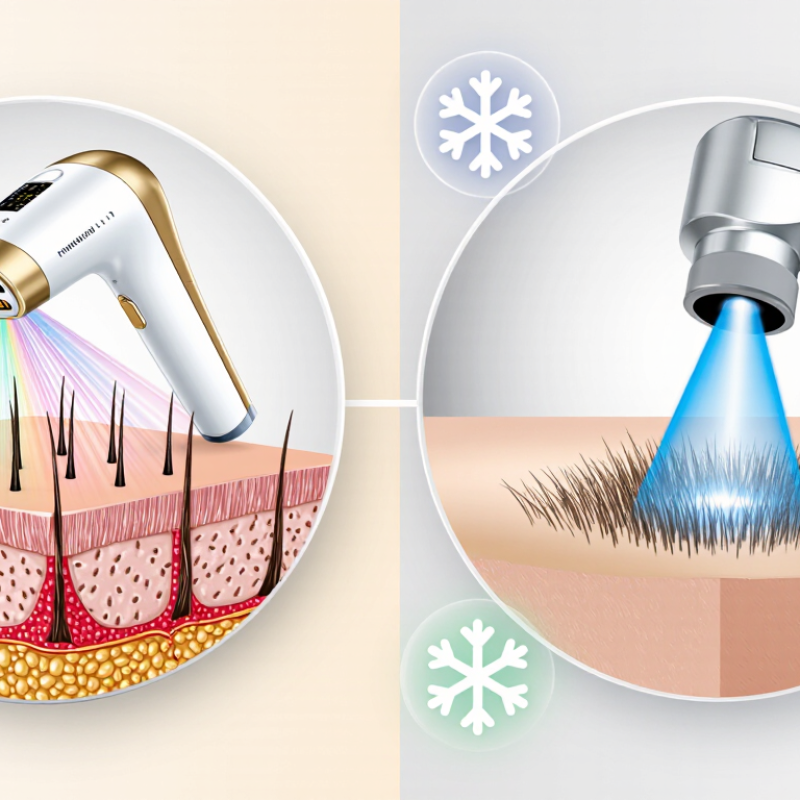
China Top IPL vs Laser Hair Removal Which Is Better?

Define IPL and Laser Hair Removal: Broad-Spectrum IPL vs. Single-Wavelength Laser

IPL and laser hair removal both use light to heat melanin in hair follicles, but their light is not the same. IPL releases filtered, broad-spectrum pulses, commonly spanning about 500–1,200 nanometers. A laser concentrates energy at a narrow wavelength, such as 755, 810, or 1,064 nanometers. These ranges are described in a clinical review by Gan and Graber in Dermatologic Surgery (2013). Put simply: IPL is a band of light; a laser is a more focused beam.

That difference affects how practitioners tailor treatment. A broader spectrum can offer flexibility, while a specific laser wavelength may suit particular skin and hair combinations. Dark, coarse hair often responds more readily because it contains more melanin; pale, gray, or red hair may respond less. It is not a perfect rule. Skin tone, treatment settings, cooling, and operator skill also matter. The review identifies several laser types and emphasizes that outcomes vary with these factors, rather than wavelength alone. A patch test and trained clinical assessment can help reduce avoidable irritation or pigment changes. Not just the device. A machine’s label cannot predict every person’s result, and comparing IPL with laser without considering individual skin and hair can be misleading.

Compare IPL’s 500–1,200 nm Range with 755, 810, and 1,064 nm Lasers

IPL systems emit filtered, broad-spectrum light, commonly spanning 500–1,200 nm; the selected filter narrows the energy reaching the skin. Lasers use a single wavelength: 755 nm alexandrite, 810 nm diode, or 1,064 nm Nd:YAG. That difference matters. Melanin absorbs shorter wavelengths more strongly, while 1,064 nm penetrates more deeply and is less strongly absorbed by epidermal melanin. A peer-reviewed review by Gan and Graber in Dermatologic Surgery (2013) found that outcomes vary across light and laser studies, with device settings and patient characteristics limiting direct comparisons. There is no universal winner.

In practice, 755 nm can suit lighter skin with dark hair; 810 nm is widely used across many treatment areas, while 1,064 nm is often considered for darker skin tones. IPL’s adjustable filters offer flexibility, but broad output is not automatically better. Hair color, skin tone, pulse duration, fluence, cooling, and operator skill all affect results. A review cannot promise your result. The FDA’s definition of “permanent hair reduction” measures stable regrowth reduction at 6, 9, and 12 months after treatment, not complete hair removal. Ask what wavelength and filter will be used, and how progress will be assessed. That detail matters.

China Top IPL vs Laser Hair Removal Which Is Better? - Compare IPL’s 500–1,200 nm Range with 755, 810, and 1,064 nm Lasers

Comparison Dimension IPL (Filtered Broad-Spectrum Light) 755 nm Alexandrite Laser 810 nm Diode Laser 1,064 nm Nd:YAG Laser
Light wavelength Typically uses a filtered range within approximately 500–1,200 nm; the delivered range depends on the filter and device. Uses a specific wavelength of 755 nm. Uses a specific wavelength near 810 nm. Uses a specific wavelength of 1,064 nm.
Light source Broad-spectrum, non-coherent pulsed light; it is not a laser. Single-wavelength laser light. Single-wavelength laser light. Single-wavelength laser light.
How it targets hair Filtered light is absorbed by melanin in the hair, heating the follicle. Results depend on the device, filter, and settings. Melanin absorbs the laser energy in the hair follicle; the 755 nm wavelength is strongly absorbed by melanin. Melanin in the hair absorbs the energy, while the wavelength allows penetration into the skin. Targets follicular melanin with less absorption by epidermal melanin than shorter wavelengths.
Common skin-tone considerations Suitability varies with the device’s filters and settings. Higher skin pigmentation can increase the risk of burns or pigment changes. Often used for lighter skin tones; greater caution is needed when the skin has more melanin. May be used across a range of skin tones with appropriate settings and practitioner assessment. Often considered for darker skin tones because epidermal melanin absorbs less energy at this wavelength; careful settings are still essential.
Hair characteristics Best suited to pigmented hair with a clear contrast from the surrounding skin; pale, grey, white, or red hair may respond poorly. Often effective for coarse, dark hair, especially when there is good contrast with lighter skin. Generally works best on pigmented hair; very light or unpigmented hair is difficult to treat. Can treat coarse, dark hair and may be selected when skin tone makes shorter wavelengths less suitable.
Precision and coverage Broad-spectrum pulses can cover larger areas, but energy is less wavelength-specific than laser energy. Focused wavelength allows targeted treatment; practical coverage depends on spot size and device design. Focused wavelength; treatment speed depends on the handpiece, spot size, and settings. Focused wavelength that can reach deeper follicular targets; treatment speed depends on the system and area.
Typical treatment course Usually requires multiple treatments because hair grows in cycles. The number and spacing vary by area and device. Multiple treatments are normally needed; hair-growth cycle and individual response affect the schedule. Multiple treatments are normally needed; the treatment plan depends on the area and response. Multiple treatments are normally needed; the treatment plan depends on the area and response.
Possible side effects Temporary redness and swelling can occur. Burns, blisters, or light or dark skin marks are possible, particularly with unsuitable settings. Temporary redness and swelling can occur. Burns and pigment changes are possible, especially if settings do not suit the skin. Temporary redness and swelling can occur; burns and pigment changes are possible with inappropriate treatment. Temporary redness and swelling can occur; careful technique is important to reduce burn and pigment-change risks.
Best comparison takeaway A broad-spectrum option whose performance and suitability depend heavily on filters, settings, and skin–hair contrast. A specific wavelength often suited to lighter skin with dark, coarse hair; skin assessment is important. A specific wavelength that can offer a balance of penetration and melanin absorption, with suitability determined individually. A longer wavelength often selected for darker skin tones, though results and safety still depend on settings and practitioner skill.

Note: Hair-reduction results vary by person, treatment area, device, and operator. These treatments generally provide long-term hair reduction rather than guaranteed permanent removal. A qualified practitioner should assess skin tone, hair type, medical history, and recent tanning before treatment.

Assess Skin Tone and Hair Color Suitability Using Dermatology Guidelines

Choosing IPL or laser starts with pigment. Both methods target melanin in the hair, so coarse, dark hair usually responds better than blond, red, gray, or white hair. The American Academy of Dermatology (AAD) says most patients need 2–6 laser sessions, but response varies with hair growth cycles and treatment area. Hair matters, too. IPL uses a broader range of light wavelengths than a single-wavelength laser, so device choice and settings matter as much as the label.

Skin tone changes the risk calculation. More melanin in the skin can absorb treatment energy, increasing the chance of burns or pigment changes if settings are unsuitable. AAD guidance notes that laser hair removal can be performed on darker skin, but an experienced medical professional and careful device selection are important. Fitzpatrick skin type can help guide assessment, yet it is not a perfect shortcut: recent tanning, uneven pigmentation, and individual sensitivity also matter. A chart cannot replace an in-person assessment.

Tips: Tell the clinician about tanning, medicines, and past pigment changes. Ask which device and settings suit your skin and hair, and whether a small test area is appropriate. Patch tests help. Take time to compare options; choosing by price alone is an easy mistake.

Sources: AAD, “Laser hair removal”; American Society for Laser Medicine and Surgery, patient guidance on laser hair removal and skin of color.

Compare Treatment Schedules with AAD’s Recommended 4–6-Week Intervals

For hair removal, the calendar matters as much as the device. The American Academy of Dermatology says laser treatments are commonly spaced four to six weeks apart. This gap lets a practitioner target hairs as they enter an active growth phase. It also gives treated skin time to settle.

IPL uses pulses of broad-spectrum light, while laser devices use a more concentrated beam. They are different technologies, though treatment plans may follow similar intervals. IPL appointments are often spaced several weeks apart, but the right schedule depends on the device, hair growth, skin tone, and treatment area. A qualified clinician should set the timing rather than copy a schedule from a chart. Timing matters.

Neither option removes every hair in one visit. Hair grows in cycles, so several sessions are usually needed, with maintenance sometimes required later. A missed appointment does not mean starting over, but changing intervals without advice may make progress harder to assess. The comparison is not perfectly tidy: IPL and laser results can vary, and suitability differs from person to person. Ask about expected sessions, skin reactions, and sun exposure before booking.

Evaluate Safety, Device Standards, and Cost When Choosing IPL or Laser

When comparing IPL with laser hair removal in China, safety starts with the device and the operator, not the treatment name. Ask whether the device has applicable NMPA registration and request its model-specific safety documentation. Relevant standards include IEC 60601-1 for medical electrical equipment and IEC 60601-2-57 for non-laser light-source equipment used in cosmetic applications. A certificate is not a guarantee of good results. Skin tone, hair color, treatment area, and operator settings all matter. Patch testing helps identify unexpected reactions.

Treatment count affects the real cost. The American Academy of Dermatology says laser hair removal commonly requires two to six sessions, with more sometimes needed. IPL also usually involves repeat visits; ask for a written estimate covering the full course, not just one session. Compare what each quote includes: consultation, eye protection, follow-up, and possible maintenance visits. The American Society of Plastic Surgeons’ procedure statistics offer useful market context, but local prices vary by city, clinic, and treatment area. A small underarm area and a full-leg course are not comparable. Very much so.

In practice, laser may suit some people seeking targeted treatment, while IPL’s broader flashes can be useful across larger areas. Neither is universally better. Ask the clinician how settings will be adjusted for your skin and hair, and what happens if irritation occurs. I would not choose on price alone; I would also check who performs the treatment and whether the clinic records settings and reactions. Some details are easy to overlook.

FAQS

How does IPL differ from laser hair removal?

IPL uses filtered light across a broad range, commonly 500–1,200 nm. Lasers use one wavelength, such as 755, 810, or 1,064 nm. More light is not automatically better.

Which wavelength may suit my skin and hair?

A 755 nm laser may suit lighter skin with dark hair. An 810 nm option is used across many treatment areas. A 1,064 nm wavelength may be considered for darker skin tones. Individual settings still matter.

Does hair color affect treatment results?

Coarse, dark hair usually responds better because treatment targets pigment. Blond, red, gray, or white hair may respond less. That can be disappointing.

How many sessions might I need?

Many people need two to six laser sessions, and some need more. IPL also usually requires repeat visits. Hair growth cycles and treatment area affect the schedule.

Does “permanent hair reduction” mean all hair disappears?

No. It refers to reduced regrowth measured over time, not complete hair removal. Some hair may return.

What should I disclose before treatment?

Mention recent tanning, medicines, uneven pigmentation, and past skin reactions. Skin tone charts help, but they cannot replace an in-person assessment.

Is a patch test useful?

Yes. A small test area can help identify unexpected reactions. Patch tests help.

What should I check before choosing a clinic?

Ask which device, wavelength, filter, and settings will be used. Request model-specific safety documents, and ask who performs treatment. Price alone misses important details.

How can I compare the real cost?

Request a written estimate for the full course, including consultation, eye protection, follow-up, and possible maintenance. A small underarm area and full legs are not comparable.

Conclusion

Choosing between IPL and laser hair removal depends on how each technology works and your skin and hair characteristics. If you are asking “what is the difference between IPL and laser hair removal,” IPL delivers broad-spectrum light, often across a range of about 500–1,200 nm, while lasers use a more focused, single wavelength. Common laser wavelengths include 755, 810, and 1,064 nm, each interacting differently with hair pigment and skin.

Both methods tend to work best on darker hair, while light, gray, or red hair may respond less reliably. Suitability also varies with skin tone, so professional assessment and appropriate device settings are important, especially for darker skin. Treatments are usually spaced several weeks apart; a schedule of roughly 4–6 weeks is commonly recommended, though individual plans vary. Before choosing, compare expected results, comfort, safety features, device standards, provider qualifications, and total cost. Neither option is universally better, and a qualified professional can help identify the safer, more practical choice for your needs.

Mason

Mason

Mason is a seasoned marketing professional with a deep expertise in the company's offerings and a passion for driving brand awareness. With a strong background in digital marketing strategies, he has an innate ability to connect with diverse audiences and effectively communicate product benefits.......